

How To Dispose Of Garlic Mustard
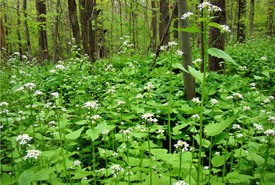
Invasive garlic mustard, Clear Creek Woods, Ontario (Photo past NCC)
Garlic mustard
Brought to North America by early colonists, this invasive alien plant is now spreading across the continent at a rate of vi,400 foursquare kilometres per twelvemonth — that's an surface area 10 times the size of Toronto.
The success of garlic mustard is multi-faceted. Aside from having no natural predators in North America, its low palatability and toxic cyanide production brand it an unfavourable pick for most native herbivores.
How is information technology identified?
In its kickoff year, garlic mustard forms a rosette of leaves that hug the ground. In the following year, the mature plants produce a flower spike up to one metre tall. The greenish leaves are heart-shaped with toothed edges and have a garlicky odour when crushed. The institute has clusters of small white flowers with four petals.
How does it abound?
Similar a cute flower patch overrun with weeds when untended by a gardener, garlic mustard can spread quickly throughout the forest understory. Its spread is facilitated by dumbo white-tailed deer populations that can over-browse native woodland plants while leaving garlic mustard ungrazed, and by intense recreational uses that disturb forest soils and spread garlic mustard seeds.
Garlic mustard is an early on riser, taking advantage of the open canopy of springtime deciduous forests, taking full reward of the commencement rays of sunlight afterward the winter snow has melted and getting a head start on native plants emerging subsequently information technology. Garlic mustard can even change a wood'due south composition over time, creating a more than favourable environment for itself, while driving other species out of the understory. This can even extend to limerick of the forest, as garlic mustard can interfere with the germination of tree seeds.
Where does it grow?
Garlic mustard occurs in southern and eastern Ontario as far due north as Sault Ste. Marie, in parts of Quebec, and south to North Carolina and Kentucky in the U.s.a.. Isolated populations have been plant in British Columbia, Nova Scotia, Prince Edward Isle and New Brunswick.
What does it threaten?
Garlic mustard's negative impact on rare West Virginia white butterflies occurs in two major ways: the reduction of native host plants in the forest understory, and the straight impact of the harmful chemicals produced by the garlic mustard plant. This is peculiarly detrimental because of garlic mustard's similarity to the rare butterfly's preferred host plant, native toothwort.
Garlic mustard closely resembles toothwort, plenty so that it can misfile West Virginia whites. As toothworts become increasingly rare in an understory dominated by garlic mustard, more and more West Virginia whites lay their eggs on garlic mustard. But garlic mustard does not sustain the West Virginia white caterpillars. The hatching rate of eggs is significantly less on garlic mustard plants than on toothworts, and those caterpillars that do hatch are poisoned by the toxic chemic present in the garlic mustard leaves they swallow.
What is NCC doing to command this species?
In the case of the West Virginia white, NCC is actively working to reduce habitat fragmentation, and to command garlic mustard populations in our own protected areas as well as surrounding areas.
NCC participates in invasive found working groups, attends conferences and produces reports on garlic mustard and other threatening invasives. Past working with partners, landowners and volunteers, NCC is making an touch in the fight to control garlic mustard.
This work benefits non only the Westward Virginia white, only all native species, plant and creature alike, including eight other rare butterfly species, 2 of which have already been extirpated from Ontario.
How can you lot help?
Everyone tin can assistance to win the battle confronting alien invasive species. Hither are some ways you tin can aid:
- Dispose of yard waste properly. Dumping yard waste matter in natural areas can introduce alien invasive species that volition thrive and spread. Even leafage piles tin be problematic, as dumped piles can smother native vegetation. Contact your municipality to find out how to dispose of yard waste properly.
- Found native species in your garden! There are lots of beautiful native species that attract native butterflies and birds, making your garden twice every bit cute. Native species are also adjusted to our climate and oftentimes require less rigorous care than exotic species.
- Written report sightings of invasive plants to your local stewardship council. Finding these invasions early on is a key to eradicating them.
- Clean your shoes or bicycle tires when moving between designated trails in dissimilar areas. Invasive plants are often spread accidentally from seeds stuck in treads.
Source: https://www.natureconservancy.ca/en/what-we-do/resource-centre/invasive-species/garlic-mustard.html
0 Response to "How To Dispose Of Garlic Mustard"
Post a Comment