

How To Find The Flux Of A Vector Field
Flux
- Page ID
- 573
Recall that a unit normal vector to a surface tin be given past
\[ \textbf{northward} = \dfrac{\textbf{r}_u \times \textbf{r}_v}{ \left| \textbf{r}_u \times \textbf{r}_v \correct| }\nonumber \]
There is some other choice for the normal vector to the surface, namely the vector in the opposite direction, \(-\textbf{n}\).
Past this point, you lot may have noticed the similarity between the formulas for the unit normal vector and the surface integral. This idea leads us to the definition of the Flux Integral. Consider a fluid flowing through a surface \(Southward\). The Flux of the fluid across \(S\) measures the amount of fluid passing through the surface per unit time. If the fluid flow is represented by the vector field \(F\), then for a minor piece with area \(\Delta S\) of the surface the flux will equal to
\[\Delta \text{Flux} = F \cdot n\, \Delta S \nonumber \]
Adding up all these together and taking a limit, we become
Definition: Flux Integral
Let \(F\) be a differentiable vector field on a surface \(South\) oriented past a unit normal vector \(n\). The flux integral of \(F\) beyond \(n\) is given past
\[ \iint_{S} (F \cdot north) d\sigma . \nonumber \]
Note that the method for choosing the value for \(d\sigma\) for flux is identical to doing it for the integrals described higher up. Also notice that the denominator of \(north\) and the formula for \(dS\) both involve \( |\textbf{r}_u \times \textbf{r}_v|\). Canceling, we go
\[ \textbf{n}\, dS = \textbf{r}_u \times \textbf{r}_v dv\, du\nonumber \]
for a surface that is divers by the function \(z = g(10,y)\), nosotros get the overnice formula
\[ \textbf{northward}\, dS = -g_x(ten,y) \hat{\textbf{i}} - g_y(x,y)\hat{\textbf{j}} + \hat{\textbf{yard}} \text{(oriented upwards)}\nonumber \]
or
\[ \textbf{n}\, dS = g_x(x,y) \lid{\textbf{i}} + g_y(ten,y)\hat{\textbf{j}} - \lid{\textbf{k}} \text{(oriented down)}\nonumber \]
Case \(\PageIndex{1}\)
Find the flux of \( F = yz\chapeau{\textbf{j}} +z^{2}\lid{\textbf{one thousand}} \) outward through the surface \(S\) cut from the cylinder \( y^{2} + z^{two} = one, z \geq 0 \), by the planes \(x = 0\) and \(x = 1\).
Solution
First nosotros summate the outward normal field on \(Southward\). This tin can exist calulated by finding the gradient of \( g(x,y,z) = y^{2} + z^{2} \) and dividing past its magnitude.
\[ northward = \frac{\nabla 1000}{| \nabla g |} = \frac{2y\chapeau{\textbf{j}} + 2z\lid{\textbf{k}}}{\sqrt{4y^{ii} + 4z^{2}}} = \frac{2y\chapeau{\textbf{i}} + 2z\hat{\textbf{m}}}{ii\sqrt{1}} = y\hat{\textbf{j}} + z\hat{\textbf{1000}} \nonumber \]
Next, we calculate the value for \(d\sigma = \frac{\nabla g}{| \nabla g \cdot p|} dA \). Note the similarity to the value of \(n\). All we need to practice is find the value of \(p\). Because our cylinder sits with its shadow region in the xy airplane, the vector normal to that region is in the \(k\) direction. Thus,
\[ d\sigma = \frac{\nabla g}{| \nabla g \cdot k|} dA = \frac{2}{2z} dA = \frac{i}{z} dA \nonumber \]
Note: we dropped the absolute value bars in the last step there because the issues specifies \(z \geq 0\) on \(S\).
Now find the value of \( F \cdot north \).
\[\begin{marshal*} F \cdot north &= (yz\chapeau{\textbf{j}} + z^{two}\hat{\textbf{k}}) \cdot (y\lid{\textbf{j}} + z\hat{\textbf{k}}) \\ &= y^{2}z + z^{three} \\ &= z(y^{two} + z^{2}) \\ &= z &\text{because the surface} \\ &&\text{is defined as } y^{2} + z^{2} = 1 \end{align*}\nonumber \]
One time all the preliminary work is done, plug them into the integral:
\[ \iint_{Due south} F \cdot n \, d\sigma = \iint_{S} \left(z\correct) \left(\frac{one}{z} dA \right) = \iint_{R_{xy}} dA = expanse(R_{xy}) = 2\nonumber .\]
Example \(\PageIndex{2}\)
Notice the flux of \(F = y\hat{\textbf{j}} - z\hat{\textbf{thou}} \) through the paraboloid \(S = y = ten^{2} + z^{two}, y \leq 1 \).
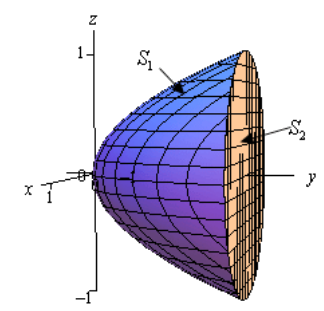
Solution
The flux tin be described by \( \iint _{South} F \cdot n \, d\sigma \) with \( n = \frac{2x\hat{\textbf{i}} - \chapeau{\textbf{j}} + 2z\hat{\textbf{k}}}{\sqrt{1 + 4x^{2} + 4z^{2}}} \).
Take the dot product of \(F\) and \(north\)
\[(0\chapeau{\textbf{i}}+y\hat{\textbf{j}}- z\hat{\textbf{k}}) \cdot \frac{2x\lid{\textbf{i}}-\lid{\textbf{j}}+2z\lid{\textbf{k}}}{\sqrt{ane+4x^{two}+4z^{2}}} = \frac{1}{\sqrt{one+4x^{2}+4z^{ii}}}(-y+2z^{2})\nonumber \]
Substitute \(10^{two} + z^{2} = y \) to simplify \(northward\) to \( -i + \frac{2z^{2}}{y} \).
Thus, the integral for the flux is
\[\begin{align*} &\int_{-1}^ane \int_{-1}^one \left(-1 + \frac{2z^{ii}}{y} \correct) dz\, dy \\ &= \int_{-1}^{one} -z + \left. \frac{2z^3}{3y} \right |_{-i}^{1} dy \\ &= \int_{-i}^{1} \left (-1 + \frac{2}{3y} \correct) - \left (1 + \frac{-2}{3y} \right) dy \\ &= \int_{-1}^{1} -2 dy \\ &= 0 \end{align*}\nonumber \]
The total flux through the surface is 0.
Example \(\PageIndex{3}\)
Find the flux of
\[ \textbf{F}(10,y,z) = 10\hat{\textbf{i}} + 2y\hat{\textbf{j}} + z\chapeau{\textbf{chiliad}}\nonumber \]
beyond the part of the surface
\[ z = x + y2 \nonumber \]
with upwardly pointing normal that lies inside the box
\( 0 \le 10 \le 3 \) and \( two \le y \le 5\)
Solution
We compute
\[ NdS = -\hat{\textbf{i}} - 2y\hat{\textbf{j}} + \hat{\textbf{k}} dy\, dx\nonumber \]
and
\[ \textbf{F} \cdot \textbf{N}\, dS = -x - 4y^2 + x + y^2 = -3y^two \nonumber \]
The flux integral is
\[ \int_0^3\int_2^5 -3y^2\,dy\,dx = -351\nonumber \]
Contributors and Attributions
- Michael Rea (UCD)
- Larry Dark-green (Lake Tahoe Community College)
Source: https://math.libretexts.org/Bookshelves/Calculus/Supplemental_Modules_(Calculus)/Vector_Calculus/4%3A_Integration_in_Vector_Fields/4.7%3A_Surface_Integrals/Flux
0 Response to "How To Find The Flux Of A Vector Field"
Post a Comment